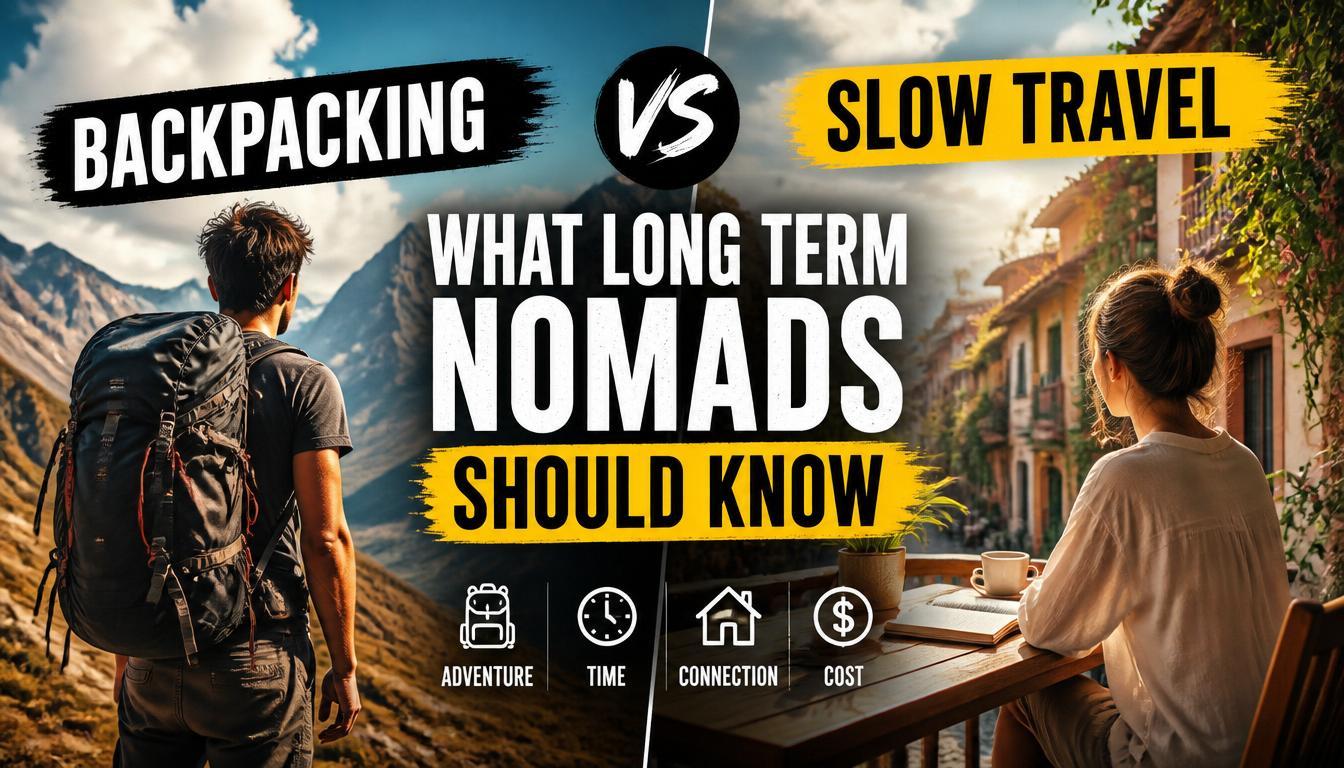
Backpacking vs Slow Travel: What Long Term Nomads Should Know
I spent my first year abroad convinced I was a seasoned slow traveler. I was completely wrong. I was just backpacking with a slightly bigger budget for private rooms while calling it something else. The real difference between backpacking and slow travel for long term nomads hit me hard the first time I actually stayed in one city for eight straight weeks. Everything shifted immediately. My daily budget dropped. My stress levels vanished. I actually experienced the rhythm of the city instead of just ticking off the main tourist sights.
What Backpacking Actually Looks Like
Backpacking is entirely about momentum. Your main goal is cramming as many destinations as possible into whatever timeframe and budget you have available.
You pack up your bags and change cities every few days. You sleep in crowded hostels or the absolute cheapest guesthouses you can find online. Every single thing you own fits inside one bag because you unpack and repack constantly. Your entire routine revolves around transit days. You spend half your trip waiting on bus station benches or sitting in train cars.
The backpacker lifestyle runs purely on spontaneity and variety. Making friends is effortless because hostel common rooms have a massive daily turnover. Plugging into the local social scene usually just means following the crowd to the nearest cheap bar. You never have time to get bored because there is always another temple to see or a new beach to visit tomorrow.
It is also incredibly exhausting. Every single move requires researching routes and booking tickets and finding your way around a new neighborhood. Living out of a backpack gets old fast. Your schedule gets ripped up and rewritten weekly. Figuring out where to do laundry turns into a massive logistical headache. Trying to maintain consistent income or focus on deep work is virtually impossible when you are constantly moving.
I spent six weeks backpacking hard through Southeast Asia. I loved every minute of the adventure. I also came home feeling completely burned out.
What Slow Travel Actually Means
Slow travel completely flips the traditional travel script. You stop trying to maximize your locations and start maximizing the depth of your experience.
You drop your bags in one place for weeks or even months at a time. You sign a short lease on an apartment or book a long-term Airbnb instead of hopping between hostel beds. You actually empty your suitcase into a real closet. You find a neighborhood coffee shop you love and figure out your favorite running route.
The goal is not to see every single landmark. The point is to actually live somewhere temporarily instead of just playing tourist.
You shed the tourist label pretty fast. You figure out exactly how the local metro system works. The person working at the corner bakery starts recognizing your face. You find a favorite noodle shop that zero guidebooks mention purely because it sits right next to your apartment and has decent Wi-Fi.
Slow travel also saves you a ton of money. Booking a monthly apartment rental costs way less than paying a nightly rate at a hostel. Buying groceries and cooking at home beats paying for three restaurant meals a day. You stop bleeding cash on constant bus tickets and flights between cities.
There is a downside though. The loneliness hits much harder when you slow down. You lose that rotating cast of instant backpacker friends. Building a real social circle takes actual effort. Some people get bored doing slow travel because the constant novelty fades away. Your crazy adventure just starts feeling like regular daily life.
Speed and Frequency of Movement
This is where the two styles divide most clearly.
Backpackers pack up and move every two to seven days. A long-term backpacker might stretch their stay in one spot to two weeks. Anything longer than that feels like standing still to someone with a backpacking mindset.
Slow travelers plant their feet for at least four weeks. Many stay in one spot for two or three months. Some stretch it out to half a year. The slower you move the more the line blurs between being a tourist and acting like a temporary local.
Your travel speed dictates everything else. It changes how you pack and where you sleep and what you actually accomplish during your trip.
Accommodation Style and Cost
Backpackers live in budget guesthouses and crowded dorm rooms booked night by night. A basic bed in Southeast Asia costs five to fifteen bucks. Expect to pay twenty to forty dollars for the same thing in Europe. Booking a private room in a hostel costs more and usually kills the social vibe that makes those places fun to begin with.
Slow travelers rent actual apartments. They use Airbnb or local Facebook groups to find monthly leases. Getting a one-bedroom spot in Chiang Mai costs roughly $300 to $500 for a month. A similar place in Lisbon runs closer to $700 or $1,200. Breaking that monthly rate down means paying maybe $10 to $40 a day for a full kitchen and a private living room.
Staying longer gives you massive negotiating power. I regularly talk landlords down by twenty percent just by offering to pay for two months upfront.
Hostels offer instant community and convenience. They are also incredibly loud and offer zero privacy. Apartments give you a comfortable home base but force you to find your own friends.
Budget Breakdown: Which Is Cheaper?
Backpacking feels cheap on a daily basis but those small costs snowball quickly.
Paying for weekly transit between cities costs $10 to $50 a pop. Eating every single meal at a restaurant because you lack a kitchen runs $10 to $25 a day. Hostel beds take another chunk of cash. Sightseeing and paying entry fees for tourist traps drains another $10 to $30 daily.
A backpacker moving fast through Southeast Asia easily spends $800 to $1,200 a month. Doing that same pace in Europe pushes the budget to $1,500 or $2,500.
Slow travelers swallow a bigger upfront cost for rent but save money everywhere else.
Monthly rent takes a bite out of the budget. But buying groceries to cook meals drops your food budget to $150 or $300 for the whole month. Buying a local transit pass is way cheaper than paying for constant intercity buses. Your sightseeing budget drops drastically because you stop trying to see everything at once.
A slow traveler sitting in a Southeast Asian city might only spend $600 to $900 a month. That same lifestyle in Europe runs $1,200 to $2,000.
Slow travel wins the budget battle if you stay long enough to make the monthly rent worth it. The break-even point usually hits right around week three or four.
Social Life and Loneliness
The backpacker social scene is incredibly easy but very surface-level.
You meet new people every single day. The common rooms and shared dorms force you to interact. Friendships spark fast because everyone is sharing the exact same experience. You end up having deep late-night conversations with someone you met just a few hours ago.
Those friendships almost never last. You both move on to different cities. You trade Instagram handles and never speak again. The connections are fun but totally fleeting.
Slow travel makes starting friendships harder but keeping them much easier.
You lose that built-in crowd of fellow travelers. Finding a community requires real intention. You have to join coworking spaces or language exchanges or hobby groups. It takes serious effort to put yourself out there.
The people you do connect with actually stick around. You see them every week. You build real routines together. I met all of my closest travel friends while sitting still for months at a time.
The loneliness is very real when you first arrive in a new city as a slow traveler. You have to be totally comfortable sitting alone in a cafe. Backpacking is definitely the better choice if you crave constant social noise.
Work Compatibility for Digital Nomads
Backpacking and working remotely mix like oil and water.
Moving constantly destroys your productivity. Changing cities kills at least half of your workday. You never know if the Wi-Fi at the next hostel will actually work. Dorm rooms are loud and chaotic. Crossing time zones rapidly messes up your meeting schedule.
I tried maintaining my freelance work while backpacking down the coast of Vietnam. I missed deadlines and felt constantly stressed before I finally just stopped working completely for three weeks. That is a terrible plan if you need income to keep traveling.
Slow travel is practically designed for digital nomads.
You get stable internet and a quiet desk. You can join a local coworking space and actually network with people. Staying in one time zone means your client calls happen at predictable times every week.
Most long-term nomads I know lean into slow travel purely out of necessity. Moving at a backpacker pace only works if you have massive savings or you are taking a complete break from your career.
Cultural Immersion Depth
Backpacking gives you a very wide but shallow view of the world. Slow travel forces you to dig deep.
Backpackers see a ton of stuff but rarely understand the context. You bounce between temples and museums and popular photo spots. You eat at the restaurants other tourists recommend. You sleep in the specific neighborhoods designed for foreign visitors.
You go home with great photos but very little understanding of how the locals actually live. You just passed through their world.
Slow travelers absorb the culture just by running daily errands.
You start shopping at the local wet markets because the produce is better. You ask your landlord where to get coffee. You figure out the local holidays and learn how to dodge rush hour traffic.
You pick up on the tiny cultural details. You learn the polite way to greet someone. You figure out why certain foods only appear on specific days. You stop feeling like a total outsider.
I learned way more about daily Portuguese life during two months in Porto than I did bouncing around Thailand for six weeks. Time makes all the difference.
Packing and Gear Requirements
Backpackers have to embrace minimalism.
Everything you own has to fit in a 40-liter bag. You carry four shirts and maybe two pairs of shoes. You ditch the heavy books and extra electronics because carrying them ruins your back.
You spend a lot of time washing socks in tiny hostel sinks. You become an absolute master at rolling your clothes to save space. You quickly figure out exactly what you actually need to survive.
Slow travelers have the luxury of carrying more weight or just buying things locally.
Staying in one spot for a few months justifies buying a cheap blender or a yoga mat. You can stock a real kitchen instead of living off street food stalls. You can even order things online and actually stick around long enough to receive the packages.
Some slow travelers keep their bags light. Others build up a small collection of comforts and just donate them before moving to the next country. You get to choose what works for you.
I carry way less stuff now than I did on my first backpacking trip. I just know what I actually use. I just like having the option to carry a little more if I want to.
Which Style Fits Long Term Nomads Better?
Most veteran nomads end up blending the two styles together.
You might rent an apartment for three months to save money and focus on work. Then you pack up and backpack through a neighboring country for three weeks just for the thrill of the adventure.
I spent a whole summer working quietly from an apartment in Lisbon. I followed that up with a fast-paced backpacking trip through Morocco before settling down again in Mexico City. Finding that rhythm keeps travel exciting.
Backpacking non-stop for a year will completely burn out your nervous system. Sitting in one apartment for too long makes you feel stagnant.
The trick is figuring out what you need in the moment. Do you need to save money and get work done? Rent an apartment. Do you have some extra cash and a craving for adventure? Grab your backpack and hit the road.
Living as a nomad does not mean picking one style forever. You just have to know when it is time to move and when it is time to sit still.
Frequently Asked Questions
Can you backpack long term or is it only for short trips?
People definitely backpack for years at a time. It requires a lot of emotional and financial endurance but it is totally possible. The secret is building rest stops into your route. Even the most hardcore backpackers eventually rent a room for a month just to recover from the constant movement.
How long do you need to stay somewhere for it to count as slow travel?
Nobody is policing the definitions but four weeks is a solid baseline. Bouncing after two weeks just feels like a slightly longer vacation. Pushing your stay to two or three months lets you actually build routines. Hitting the six-month mark basically makes you a temporary local resident.
Is slow travel boring compared to backpacking?
It definitely can be if you pick a sleepy town or just stay too long. You are trading the thrill of constant movement for deeper local experiences. Some travelers go crazy without new daily stimulation. Others find the fast pace exhausting and love having a predictable routine. You have to test both styles to see how your brain reacts.
Which is better for solo travelers, backpacking or slow travel?
Hostels make backpacking the easiest way to make friends quickly. Slow travel asks you to work much harder to build a social circle but those friendships usually last longer. Solo backpackers almost never have time to feel lonely. Solo slow travelers definitely hit some rough patches in those first few weeks. Start with backpacking if you are nervous about feeling isolated.
Can you switch between backpacking and slow travel on the same trip?
That is exactly what most long-term travelers do. You rent a place when you need to focus on work and save cash. You switch back to backpacker mode when you want to explore a new region quickly. Nobody forces you to stick to one specific travel style. Changing your pace keeps the whole experience fresh.